








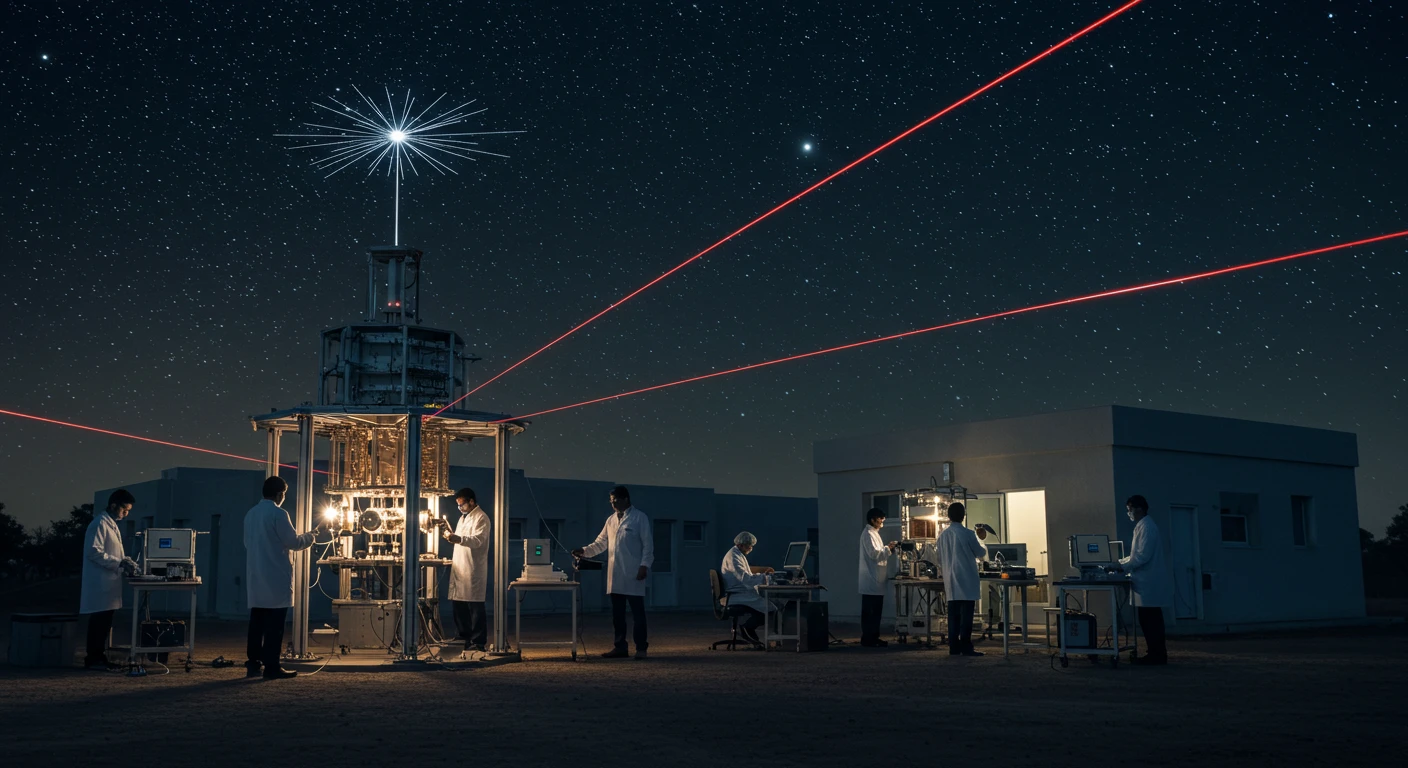
India’s recent triumph in demonstrating quantum entanglement-based free-space quantum secure communication over 1 km, as announced by the DRDO and IIT Delhi, is a moment of immense pride for the nation. This achievement, a shining testament to India’s increasing scientific prowess, marks a bold step into the elite realm of quantum communication, a field where Bharat is steadily carving its name alongside global giants. With the tricolor flying high, this milestone showcases the brilliance of Indian scientists and engineers, fueled by the indomitable spirit of innovation and self-reliance. However, let’s ground this patriotic fervor in a clear-eyed comparison with China’s quantum communication juggernaut, which remains the global frontrunner.
India’s Quantum Leap: A Proud Milestone
The successful 1-km free-space quantum communication demo, rooted in the complex phenomenon of quantum entanglement, is a feather in India’s cap. It’s not just a scientific breakthrough; it’s a clarion call that Bharat is ready to compete in cutting-edge technologies critical for national security and global influence. This achievement, driven by the synergy of DRDO’s strategic vision and IIT Delhi’s academic brilliance, underscores India’s resolve to master quantum key distribution (QKD), a technology that promises unbreakable encryption for secure communications. For a nation that has already conquered space with Chandrayaan and Mangalyaan, this is another step toward technological Atmanirbhar Bharat (self-reliant India), ensuring our defense and communication systems are fortified with homegrown innovation.
China’s Quantum Dominance: The Global Leader
Yet, in the spirit of truth, we must acknowledge that China remains the undisputed titan in quantum communication. Their Micius satellite, launched in 2016, achieved satellite-based QKD over thousands of kilometers, including a staggering 7,600-km intercontinental link with Austria. Their 2,000-km Beijing-Shanghai fiber-optic quantum network, operational since 2017, is a marvel of scale and ambition, securing communications across vast distances. China’s investments, backed by massive state funding and a head start of nearly a decade, have placed them light-years ahead in infrastructure, distance, and practical deployment. Their quantum ecosystem is a well-oiled machine, integrating satellites, ground stations, and urban networks, a feat India is yet to match.
Does India Have an Edge?
While China’s lead is formidable, India’s achievement carries unique strengths that spark hope and pride:
- Indigenous Innovation: India’s 1-km free-space QKD demo is a homegrown triumph, crafted by Indian minds on Indian soil. Unlike China’s reliance on large-scale state-driven programs, India’s progress reflects a lean, focused effort, leveraging institutions like IIT Delhi and DRDO. This self-reliance is a strategic edge, ensuring Bharat’s quantum future isn’t tethered to foreign technology, a matter of national pride and security.
- Focus on Free-Space Challenges: Free-space QKD, as demonstrated by India, tackles the tricky problem of transmitting quantum signals through the atmosphere, battling turbulence and photon loss. This aligns with India’s strengths in space technology (hello, ISRO!). While China excels in satellite-based QKD, India’s groundwork in free-space systems could pave the way for satellite-to-ground quantum links, positioning Bharat to leapfrog into space-based quantum networks.
- Strategic Agility: India’s smaller-scale but targeted achievement allows for nimble progress. While China’s massive infrastructure is impressive, it’s also complex and resource-intensive. India’s focused approach could enable faster iteration and adaptation, especially for defense applications where DRDO’s expertise shines.
However, the edge is not yet decisive. China’s quantum communication capabilities spanning longer distances, mature networks, and global firsts place them firmly ahead. Their satellite-based systems and extensive fiber networks dwarf India’s 1-km free-space demo in scale and readiness. India’s achievement, while a proud milestone, is a stepping stone rather than a leap past China.
The Path Forward: Bharat’s Quantum Quest
India’s quantum journey is just beginning, and the nation’s spirit of Viksit Bharat (Developed India) fuels optimism. To close the gap with China, India must:
- Scale Up: Extend free-space QKD to tens or hundreds of kilometers and integrate with ISRO’s satellite capabilities for global reach.
- Build Networks: Invest in a national quantum communication network, akin to China’s Beijing-Shanghai link, to secure civilian and military communications.
- Global Collaboration: While staying self-reliant, India can learn from global players like Europe’s Quantum Flagship or Japan’s NICT, blending international expertise with desi innovation.
Conclusion
India’s 1-km quantum communication triumph is a beacon of national pride, a testament to the brilliance of Bharat’s scientists and the resolve of its institutions. It signals India’s arrival on the global quantum stage, ready to secure its future with cutting-edge technology. Yet, in the spirit of truth, China’s quantum empire built on satellites, sprawling networks, and years of investment remains the gold standard. India’s achievement doesn’t yet give it an edge over China, but it’s a powerful first salvo. With the same passion that launched Chandrayaan to the moon, Bharat can harness its ingenuity and determination to challenge the dragon’s lead, making the world take notice of a rising quantum powerhouse. Jai Hind!